Archery Bastions: Castle War
- 4.5
- Rating
- 10.00M
- Installs
- Free
- Price

 Analysis by App-foxy
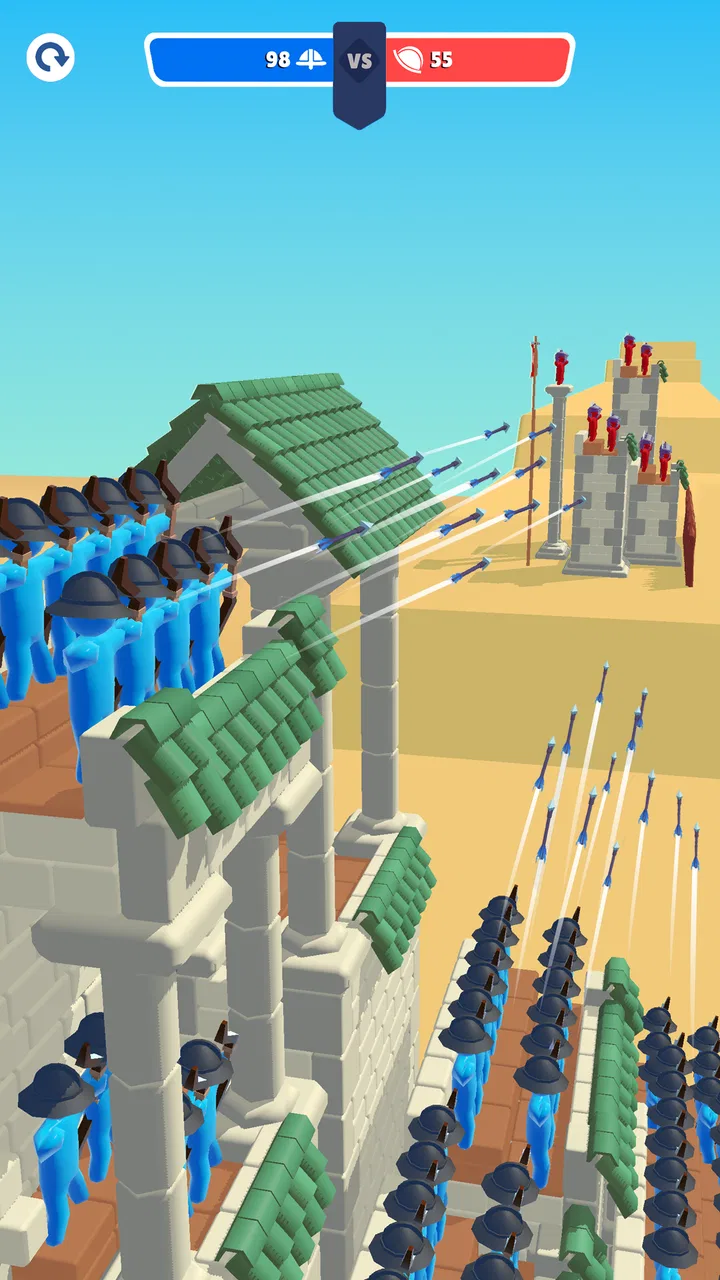
Archery Bastions: Castle War caught my attention because it turns a familiar castle-defense idea into something I can understand almost immediately: line up a shot, release the arrow, and watch the opposing stickmen fall. That directness is its biggest strength. I do not need a long tutorial or a complicated build system before the first satisfying hit. It is a free arcade game from CASUAL AZUR GAMES, rated 4.6 from around 126 thousand ratings, and its audience size is reflected in more than 10 million installs.
After spending time with it, I see the game as a good fit for short bursts rather than a deep strategy commitment. The appeal is not in creating a huge long-term plan; it is in the tiny decisions that happen between drawing the bow and seeing whether the castle survives. A spare minute can be enough for a few attempts, while a longer break can turn into a relaxed run through several encounters.
The important question is not whether the game is complex, but whether its simple shooting loop stays enjoyable after the first few rounds. For me, the answer is mostly yes, provided I approach it as a light arcade distraction instead of a serious tactical game.
You May Also Like

 Blood Strike: 2.5 Anniversary
Blood Strike’s Loadouts Turn Every Drop Into a Tactical Gamble
A close look at Blood Strike’s custom loadouts: how fast access to signature weapons reshapes its battle royale rhythm, rewards preparation, and narrows the gap between fights.

 Pandora - Music & Podcasts
Pandora’s Music Is Easy to Start, but Harder to Recover
Pandora’s strength is its low-effort path from a seed to a station. Its weak spot is how much confidence it asks you to place in connection, setup, and quiet recovery.

 8 Ball Pool
 Is Built on Rivalries, Rematches, and Routine
A close look at the rivalries, rematches, shared routines, and unanswered safety questions that turn a quick pool match into a persistent mobile community.

 Samsung Music
’s Quiet Strength Is Playing What You Already Own
Its reach comes less from spectacle than from dependable access to a personal library. That simplicity is both the app’s strongest retention engine and its ceiling.

 AccuWeather: Weather Radar
AccuWeather Review: A Quick, Clear Forecast for Everyday Decisions
For everyday plans, the best forecast is the one you can understand quickly. AccuWeather makes rain timing, radar, and local conditions easy to act on, with a few trade-offs.

 Hill Climb Racing
Why Hill Climb Racing Still Turns Crashes Into One More Run
A tiny car, a bumpy hill and one more upgrade: Hill Climb Racing keeps resurfacing because its simple chaos makes every near-miss feel personal.
More From Our News Desk



Why the first few shots work so well
I enjoy how quickly the game teaches its central rhythm: look over the castle, choose a target, and make a deliberate shot. This section is about why that first loop feels so inviting, while also setting up the practical question of how comfortably it fits around everyday interruptions.
A clear objective with almost no friction
The central idea is easy to grasp: use a bow to attack castle defenders and destroy the stickmen standing in the way. That clarity matters on a phone, especially when I am opening a game during a short wait or while taking a break from something else. The screen gives me an immediate goal, and the action begins without asking me to learn a large collection of systems first.
I like that the basic pleasure comes from the shot itself. There is a small moment of judgment before releasing the arrow, followed by instant visual feedback. A clean hit feels rewarding because I can connect my action with the result. This is more satisfying than an arcade game where success depends mostly on tapping at the right time without any sense of control.
The stickman presentation also helps. It keeps the battles readable and avoids visual clutter, so I can focus on the castle, the targets, and the trajectory of the attack. The style is deliberately simple rather than dramatic. Players looking for elaborate character animation or a cinematic medieval world will probably find it too plain, but that plainness supports the quick-session design.
How I approach a new encounter
My first instinct is not to rush the shot. I look at the arrangement of the defenders and consider which target seems most important or easiest to remove. Even when the decision is straightforward, that brief pause gives the action a little more weight. I am not simply pressing a button; I am making a small visual calculation and then checking whether my judgment was correct.
A useful habit is to treat each attempt as a quick experiment. If a shot does not work, I pay attention to what caused the miss instead of repeating the same movement automatically. That makes the game feel less random from my perspective. The best moments come when I adjust my aim slightly, land the arrow where I intended, and clear a troublesome position.
This is also where the game separates itself from very basic tap-to-score arcade titles. The interaction is still accessible, but it gives me a little more involvement than simply waiting for a prompt and touching the screen. The trade-off is that the simplicity can become predictable if I want a constantly changing challenge.
The satisfaction of a short successful run
Archery Bastions: Castle War is at its best when I have only a small amount of attention available. I can play while waiting for a coffee, between messages, or during a short commute break, assuming I am not the one driving. A successful encounter delivers its reward quickly, so I do not need to reserve a long uninterrupted block of time to feel that I have made progress.
That makes it more approachable than many strategy games in the same broad space. Usual castle-defense alternatives often expect me to place units, manage resources, upgrade several structures, or follow a longer campaign. Those games can offer more depth, but they also demand more concentration. Here, the entry cost is much lower: I can start thinking about the shot almost as soon as the game is open.
The downside is equally clear. If I am searching for a rich defensive system where every placement creates a different strategic puzzle, this is not the stronger choice. Its pleasure comes from aiming and clearing targets, not from building a detailed fortress economy.
Short sessions, interruptions, and returning later
For me, the easy-to-resume action is a real advantage when a spare moment gets cut short; I can return without rebuilding a complicated plan. I’ll look at how to make those brief visits feel purposeful, then turn to the habits that can keep repeated encounters from becoming automatic.
A rhythm that suits casual play
The game’s rhythm feels naturally divided into small pieces. I can make a few shots, finish a brief sequence, and put the phone down without feeling that I have abandoned a complicated operation. That is valuable for players who dislike games that punish them for leaving after only a minute or two.
I also appreciate that the action is easy to resume mentally. When I return, I do not have to remember a large collection of objectives or reconstruct a complicated plan. The immediate task remains understandable: inspect the castle, aim at the stickmen, and fire. This low memory burden is one of the strongest reasons I would recommend it to someone who wants a game for fragmented free time.
For a realistic everyday example, I could open it during a queue, complete a few attacks, lock the phone, and come back later without needing to read a long explanation of what happened. That kind of interruption tolerance is more important than it sounds. Plenty of mobile games are enjoyable only when I can give them sustained attention; this one is more forgiving of a stop-and-start routine.
What happens when attention is limited
Short-session games still need to communicate clearly when I am distracted, and this one benefits from keeping its main action visually obvious. I can usually tell what I am supposed to do without searching through menus. That makes it suitable for a quick mental reset, although I would not call it ideal for playing while multitasking heavily. Aiming still deserves enough attention to avoid careless misses.
My practical advice is to use it as a deliberate five-minute break rather than something to play constantly in the background. The game is simple enough to open casually, but the shooting remains more enjoyable when I give each attempt a little focus. If I am answering messages at the same time, the satisfaction of accurate shots drops because I am no longer engaging with the small aiming decisions.
Players may also wonder whether the free download means the experience is completely free of spending pressure. The game is free to play, but in-app purchases range from $1.99 to $49.99 per item. That does not automatically make the experience unsuitable, yet it is worth remembering before handing the phone to a child or allowing unrestricted purchases. The age rating is Everyone 10+, so families should still consider how they want to handle optional spending.
Returning after several days
The strongest reason to come back is convenience rather than a large narrative mystery. I can return because the core action is familiar and immediately available. That is useful when I want something dependable, but it also reveals the game’s main limitation: players who need a constantly evolving reason to play may lose interest sooner.
Compared with a traditional arcade game built around chasing a high score, the castle setting gives the shots a little more context. Compared with a full tower-defense game, however, the strategic layer is lighter. I would choose this one when I want direct interaction and quick feedback; I would choose the deeper alternative when I want planning, resource management, and a longer session.
Where the replay value comes from—and where it fades
I find the replay value in small adjustments—taking a moment to read the defenders and learning from a shot that misses—rather than in a deep strategic layer. That makes the game pleasant in short doses, though it also gives experienced players a clear point at which they may want a more varied challenge.
Small decisions can create replayable moments
Replay value comes from trying to improve the quality of my decisions. I may replay a section because I want a cleaner sequence of hits, a better approach to the defenders, or simply another chance after an imperfect attempt. The game encourages me to notice the difference between an intentional shot and a rushed one.
One non-obvious strength is that the simple presentation makes mistakes easy to diagnose. In a visually crowded action game, I may not know whether I failed because of timing, positioning, or an effect I missed. Here, the limited visual language makes me look more carefully at my aim. That gives the game a modest learning loop: observe, shoot, identify the problem, and adjust.
Another useful approach is to vary the order in which I think about targets rather than always attacking the most obvious figure first. Even when the game’s situations are compact, changing my attention can make familiar encounters feel less automatic. I do not expect endless strategic variety from this, but it helps preserve the feeling that I am playing rather than merely repeating a gesture.
The repetition problem is real
Eventually, the same strengths can become weaknesses. The controls are easy to understand, the objective is direct, and the visual style is restrained. Those qualities make the first session welcoming, but they also leave fewer layers to discover. If I play for a long time without a break, the loop can start to feel more like routine than challenge.
This is why I would not recommend treating it as my only mobile game. It works better alongside something with a different pace. I might use it for quick archery action, then switch to a puzzle game when I want more mental variety, or to a deeper strategy title when I want a longer planning session. Its role is clear, and it does not need to replace every other type of game.
The trade-off is especially important for experienced arcade players. Someone who enjoys mastering precise controls may find the accessible shooting too limited after the novelty fades. On the other hand, a newcomer who finds elaborate games intimidating may appreciate that the game gives immediate feedback without demanding expert knowledge.
Who should install it
I would suggest it to people who want a free arcade game that can be understood quickly, played in short sessions, and paused mentally without a complicated restart process. It is also a reasonable choice for anyone who likes the basic satisfaction of aiming at visible targets and seeing a direct result.
It suits younger and casual players who enjoy a simple castle battle theme, while the Everyone 10+ rating gives families a useful starting point for deciding whether it matches their household. I would still keep purchase controls in mind because the optional items can become expensive at the upper end of the listed range.
I would skip it if my priority were a deep campaign, elaborate castle construction, competitive multiplayer, or a highly varied progression system. Those expectations point toward a more substantial strategy or action game. This title is better understood as a focused arcade diversion, not as a replacement for a full-scale medieval tactics experience.
My casual verdict after living with the loop
Archery Bastions: Castle War succeeds because it respects the value of a quick, understandable interaction. I can open it, recognize the objective, make a shot, and know almost immediately whether my decision worked. That is exactly the kind of clarity I want when I have only a few minutes and do not want to study menus or remember a complex plan.
Its interruption-friendly rhythm is another genuine advantage. I can stop after a small piece of play and return later without losing the basic thread. For everyday mobile use, that matters more to me than a large feature list. The game feels comfortable in the gaps of the day, especially when I want something active but not mentally exhausting.
Still, the same focused design limits its long-term variety. The shooting loop has charm, but it may not hold the attention of players who need deep systems or major changes from one session to the next. I also recommend being conscious of the in-app purchase range, particularly when children use the device.
With version 0.20.4 and a minimum operating system requirement of 11, the practical question is whether the phone can run it and whether this style of quick archery appeals to you. The game was released on January 23, 2022, and its continued reach suggests that the central idea has found a broad casual audience. I would install it for short breaks, quick attempts, and that small pleasure of landing a well-judged arrow.
My recommendation is simple: choose it for immediate arcade satisfaction and flexible sessions, but look elsewhere if you want a deep castle strategy game. It does not try to be everything, and that is why it works when I need a lightweight game that gets to the action quickly.
FAQs for Archery Bastions: Castle War
01What is the main objective of Archery Bastions: Castle War?
Archery Bastions: Castle War is a strategic game where players aim to conquer enemy castles using archery skills. The main objective is to destroy the opponent’s bastions by strategically deploying your archers and utilizing special abilities to gain an advantage. Success requires careful planning and tactical execution.
02Is Archery Bastions: Castle War free to play?
Yes, Archery Bastions: Castle War is free to download and play. However, it includes in-app purchases that allow players to buy additional resources or unlock special features. While these purchases can enhance gameplay, they are entirely optional and players can progress without spending any money.
03What are the system requirements for Archery Bastions: Castle War?
Archery Bastions: Castle War is available for both Android and iOS devices. For Android, it typically requires version 5.0 or higher, and for iOS, version 10.0 or later is recommended. The game runs smoothly on most modern smartphones and tablets, ensuring a seamless gaming experience.
04Does Archery Bastions: Castle War have multiplayer features?
Yes, Archery Bastions: Castle War includes multiplayer features, allowing players to engage in battles against friends or other players globally. This adds a competitive edge to the game, as players can test their strategies and archery skills in real-time duels, enhancing the overall excitement and challenge.
05Are there any tips for beginners in Archery Bastions: Castle War?
For beginners in Archery Bastions: Castle War, it's important to focus on upgrading your archers and unlocking new abilities as you progress. Pay attention to the strengths and weaknesses of different characters, and practice aiming to improve accuracy. Additionally, learning to predict enemy moves can give you a strategic advantage.
Pros
- Engaging and strategic gameplay.
- Stunning graphics and animations.
- Variety of levels and challenges.
- Smooth controls and interface.
- Regular updates and events.
Cons
- Occasional in-app purchases.
- Ads can be intrusive at times.
- Requires constant internet connection.
- Battery consumption is high.
- Limited customization options.

Archery Bastions: Castle War
Gallery